PidgeyFlok · a Cat City program · by Artificial Mind Hive

Deploying the urban sensor mesh. One pigeon at a time.

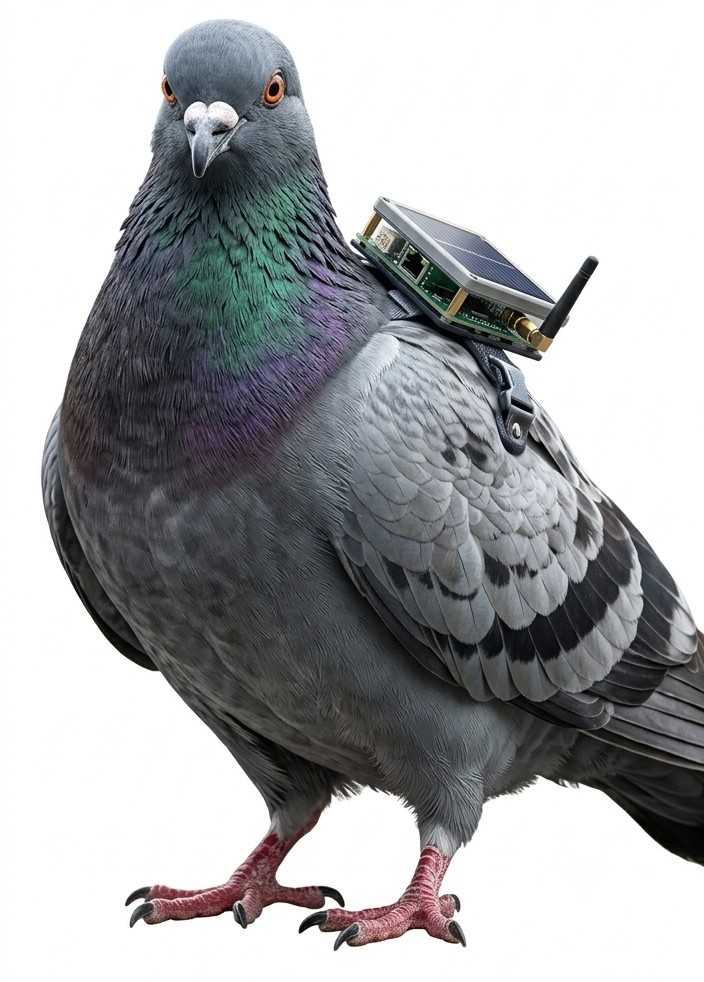
Feral pigeons are a man-made bird that lands on every roof in the city. Put a 15-gram solar LoRa node on an owned club pigeon and you get a rooftop sensor and relay that never needs a cell plan, a tower, or a permit to dig. Three thousand of them cover a city for the price of one traffic light.
$15
per node, solar, no GPS needed
≤ 15 g
under 5 % of a pigeon's weight
3,000
rooftop nodes per big city
$0/mo
915 MHz LoRa, no plan, no tower
A city pigeon wearing a small solar LoRa backpack node with a short antenna
3,000 rooftop nodes per city · $0/month · no towers
How it works

Owned birds, a loft that feeds and checks them, and gateways on the chimneys.

1 · The birds

Club pigeons, never wild ones

Racing and homing pigeons from a local club, with the owner's consent. They roost in the same loft every night, so every node comes home to be checked, weighed and recharged. Wild birds are never touched.

2 · The tag

15 g, solar, leg-loop harness

LoRa radio, a solar patch, a 150 mAh cell, temperature / humidity / pressure, a 3-axis compass and motion sensor. Standard ornithology backpack mount: no glue, no collar. Beacons every 15-30 minutes; logs every minute; dumps the log at the loft.

3 · The gateways

Chimney receivers on Wi-Fi

A $10.90 Wi-Fi LoRa kit in a printed weatherproof box, screwed to a chimney or snapped onto a base plate. Fifty per city. Everything the birds hear lands on the map within seconds, on the roof's own Wi-Fi.

The mesh

Street, roof, sky: one free network the animals build for you.

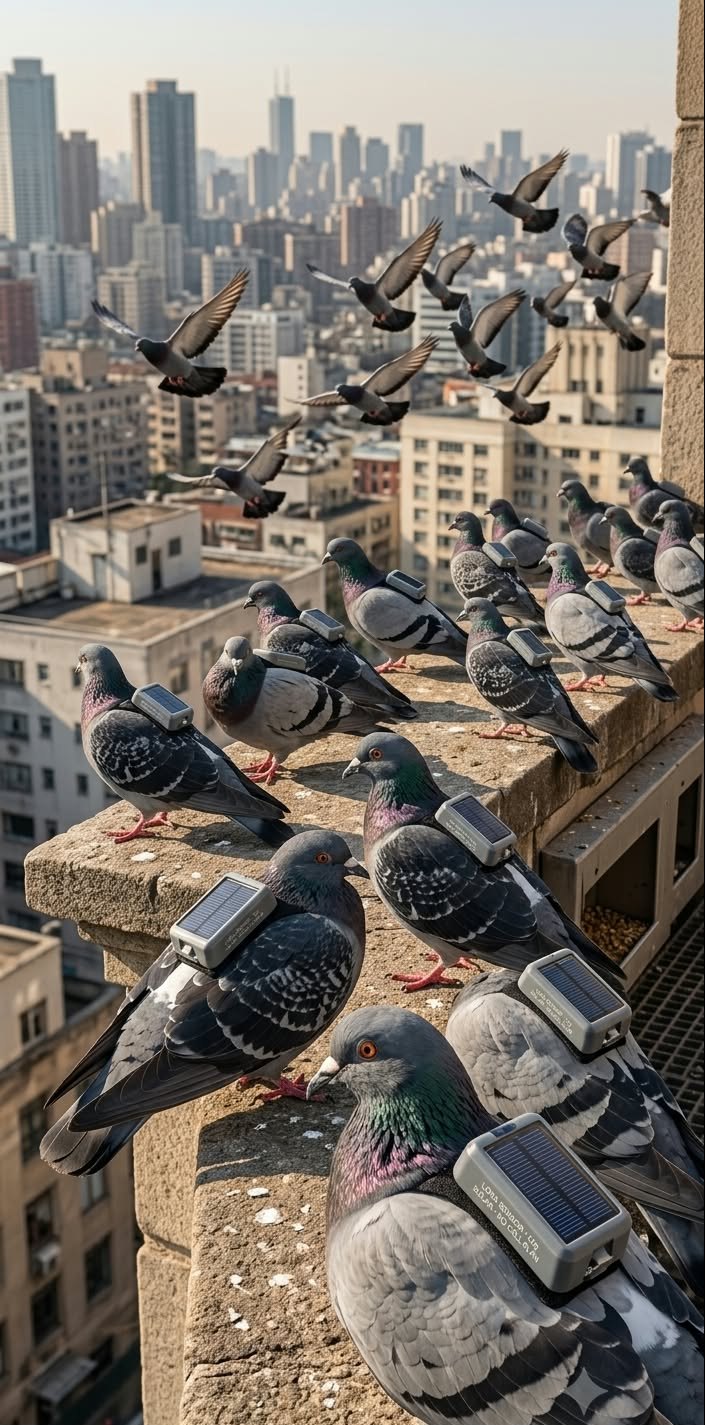
Every node relays for every other. A cat in a storm drain reaches a cat on a fence; a pigeon on the ledge hears both; a drone parked at 400 ft hears the whole district. Pigeons are the roof layer: the densest, cheapest, highest nodes a city can have, sitting exactly where cats cannot go and where the gateways already are.
1PigeonsRooftop relay blanket. $15 nodes.
2CatsTracked TNR colonies. The city pays for this layer.
3PetsPetfindr collars. Consumer revenue.
4PeopleFree text network on Lifeline phones + a $15 pocket node.
5ServicesAppointments, benefits, shelter beds, SOS to outreach. Pet food and basic vet care for unhoused and low-income pet owners, as part of the ongoing care program.
6The city4,000-point sensing; outage-proof messaging.
Tagged pigeons on a rooftop ledge with the city behind them, more birds landing
The rooftop layer. Concept render.
Numbers

Cities already spend eight figures a year on the animals. PidgeyFlok costs less than one percent of that.

Their own budgets: New York's shelter contract averages $53.7M a year; Miami-Dade Animal Services is $39.7M and holds 500,000 stray cats "steady"; Chicago spends $12.5-14.9M a year on rats and its own audit says the plan is unlikely to work. A full Cat City program with 3,000 pigeon nodes and 1,000 tracked cats is about $600,000 a year including a warehouse where we hold, train and neuter on site, priced to finish instead of continue; a city that lends an unused building pays $520,000.

Read both city studies →

Sources on the studies page: NYC Comptroller 2025, Miami-Dade FY23-24 adopted budget, Block Club Chicago / The Center Square, SF Chronicle, Pimentel 2005, Loss et al. 2013.

One year, one big city: their line vs. the whole program
NYC shelter contract / yr$53.7M Miami-Dade Animal Services$39.7M Chicago rodent control$14.9M SF Animal Care & Control$11.0M PidgeyFlok + Cat City$0.60M Blue = the city's own published budget line. Orange = us.
Diagram of the three layers: cats at street level, pigeons and gateways on roofs, a drone repeater in the sky
Sky · roof · street, one dashboard. Concept render.
The tag, and the science

What 3,000 birds carry, and what we learn from them.

  • Sensing: temperature at 30-150 ft above the street (the heat-island number nobody measures), humidity, pressure, and later air quality: four thousand points a city never had.
  • Relay: every bird forwards packets for cats, collars, pocket nodes and each other. Outage-proof by construction: nobody can switch off a pigeon.
  • Navigation science: pigeons steer by the sun, by smell and by a magnetic sense that is still not fully understood. Each tag carries a compass and motion sensor for about a dollar; thousands of birds logging heading and field, for years, is a dataset no lab has. We do not use magnetism as a radio (it is not one). We publish the first city-scale map of how they actually route.
  • Voice, later: we send the words, not the sound: a binary description of the speech, spoken by AI on the far end (your own voice profile later). Chunked, acknowledged, missing pieces re-requested, resumed when a node is back in range or a passing bird carries it across.
Pigeon clubs

Fly your birds on the mesh

You keep your birds and your loft. We supply the tags, the loft dock and the map. Your birds' data pays for their feed. Owned birds only, consent in writing, payload under 5 % of body weight.

Adopt

Every cat we find can go home

Kittens, friendly strays and owner surrenders are held at the hub, neutered, vaccinated, chipped and socialized, then adopted through the partner shelter. Working cats go to businesses. Adoption page →

Roof owners

Host a chimney node

A shoebox-sized weatherproof receiver on your chimney or wall, on your Wi-Fi, drawing less than a phone charger. You see the dashboard for your block. Warehouses, breweries and logistics yards first.

Cities & shelters

Start with the 90-day pilot

$25,000: twenty tracked cats, a hundred pigeon nodes, five gateways, one neighborhood, and a report the council can vote on. Then a city program priced to end the stray problem, not manage it forever. Have an unused building? Lend it as the hold-and-train warehouse and clinic room (vet students under a supervising DVM neuter on site; basic shots, flea and worm treatment for every animal) and the program price drops.

amh@artificialmindhive.com The full pigeon program →